A digital twin for modelling and forecasting induced seismicity
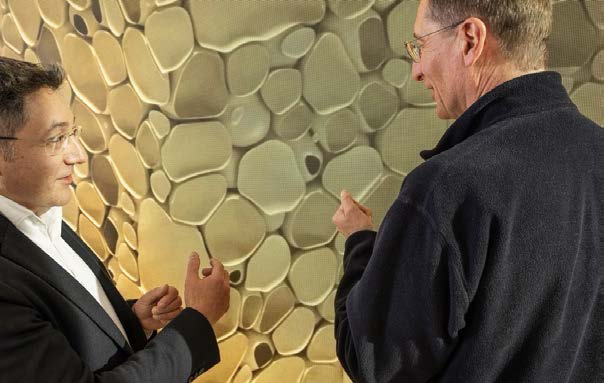
I am the PI (co-PI Prof. Toschi TU/e) of this 4 year project, which is part of the NWO DeepNL Programme and started mid-2024. Further information can be found on the project home page. Federico and I discussing a particular soft glass configuration
Summary
We propose a numerical model capable to predict observed seismicity (size, time and location of events) based on a known fault geometry and forcing. The model will be applied to Groningen where the forcing is due to gas production. Each induced earthquake produces ground acceleration felt by the population. We will use ground accelerations from our numerical model to develop a machine learning tool able to forecast timing and size of the next event. This can be used to assess seismic hazard due to gas production, tune production to safe levels and estimate seismicity after production stops
Comprehensive monitoring and prediction of seismicity within the Groningen gas field using large scale field observations
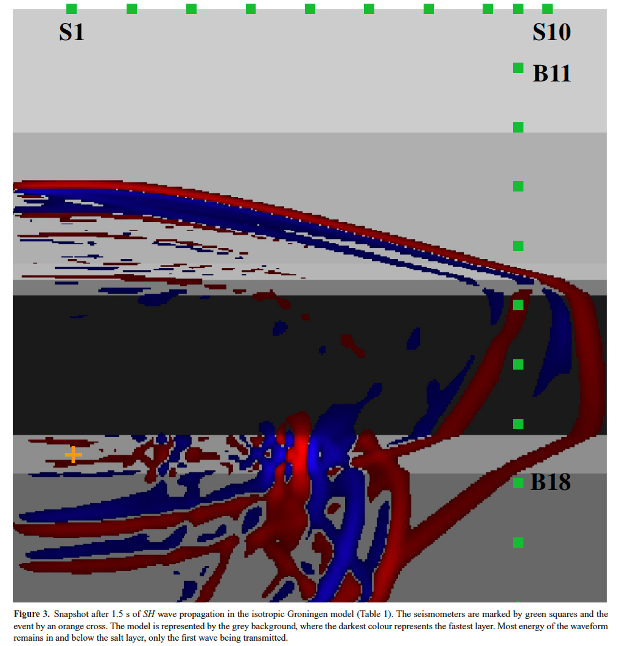
I was the PI of this 5 year project (2019-2025), which is part of the NWO DeepNL Programme. Results can be found on the project home page. Numerical wavefield across the Groningen gas field
Summary
It is well known that the seismicity in the Groningen area is due to gas extraction. The dynamics of how the rate and place of extraction is related to the magnitude and frequency of seismicity, however, is not understood. In a synergetic collaboration between the Department of Applied Mathematics at the University of Twente and the Department of Earth Sciences at Utrecht University, we propose to develop state-of-the-art tools to comprehensively address this extraction-seismicity causality.
EPOS-NL
I am an original co-PI of this NWO funded infrastructure project, which started in 2019. Detailed information can be found on the project home page.
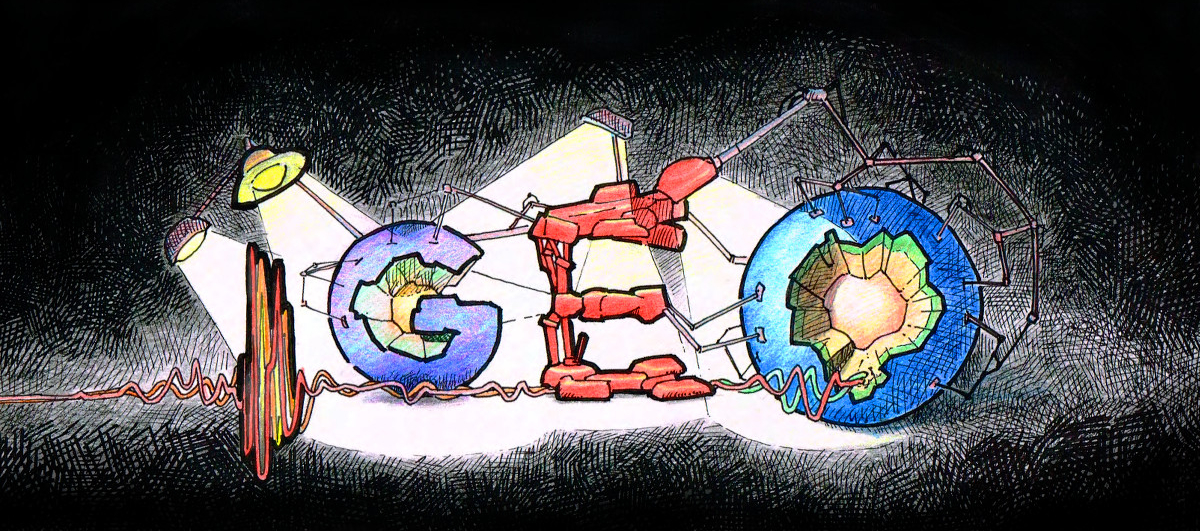
iGEO
My 5 year ERC-Adg project (2013-2018) aimed at reconciling the views of geophysics and geochemistry on the Earth's deep mantle. The work was done in collaboration with the group of Paul Tackley at ETH. Further information can be found on the project home page.
NARS
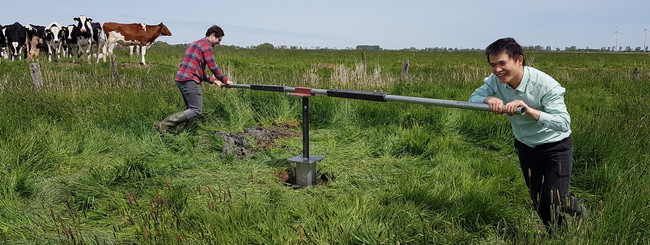
I was managing the NARS network during most of my time in Utrecht. NARS was a mobile seismic network operated by the seismology group of the Department of Earth Sciences at Utrecht University. It was the first digital mobile broadband seismic network (Nolet & Vlaar, 1982) and has been operational since 1983. In 2025, we stopped operating NARS and donated the equipment to KNMI and Twente University. NARS stations were deployed in various configurations within Europe through NARS projects (Europe, ILIHA, NL, DEEP, Netherlands, DeepNL Groningen) or as part of other projects (SVEKALAPKO, IberArray). NARS was also deployed around the Gulf of California (Baja) and in Botswana. Currently the stations are in the Netherlands as part of the NWO research program DeepNL. The instrumentation changed over the years. Detailed information can be found on the project home page. Manual drilling for a seismometer installation in North-NL